
You are here : Home > News and resources > L&D Insights > Project management > Project Management Archetypes: A Guide to Leadership Styles
Project Management Archetypes: A Guide to Leadership Styles

Project success isn’t about the one perfect style, but recognising your strengths, your blind spots, and how your approach shapes an entire project journey.
Every project manager shows up with a unique style — a blend of habits, instincts, and priorities that shape how they lead. Just like selecting your character in a video game, understanding your archetype helps you anticipate challenges, play to your strengths, and collaborate more intentionally with others.
Whilst every organisation has its own rhythm, what remains clear is that when you understand your own archetype, you have the advantage of leading projects with clarity, confidence, and self-awareness.
The Project Management Archetypes
These archetypes aren’t job titles — they’re styles. Most project managers will recognise themselves in more than one, often shifting depending on the project stage, organisation culture, or team dynamic. What matters is developing an awareness of your dominant archetype, acknowledging your blind spots, and learning to flex when the project requires it.
Understanding these styles also helps team members benefit their careers by actively identifying the specific archetype their manager falls into and effectively working alongside their traits.
Every project is its own quest. So, choose your character with intent and focus on your strengths.
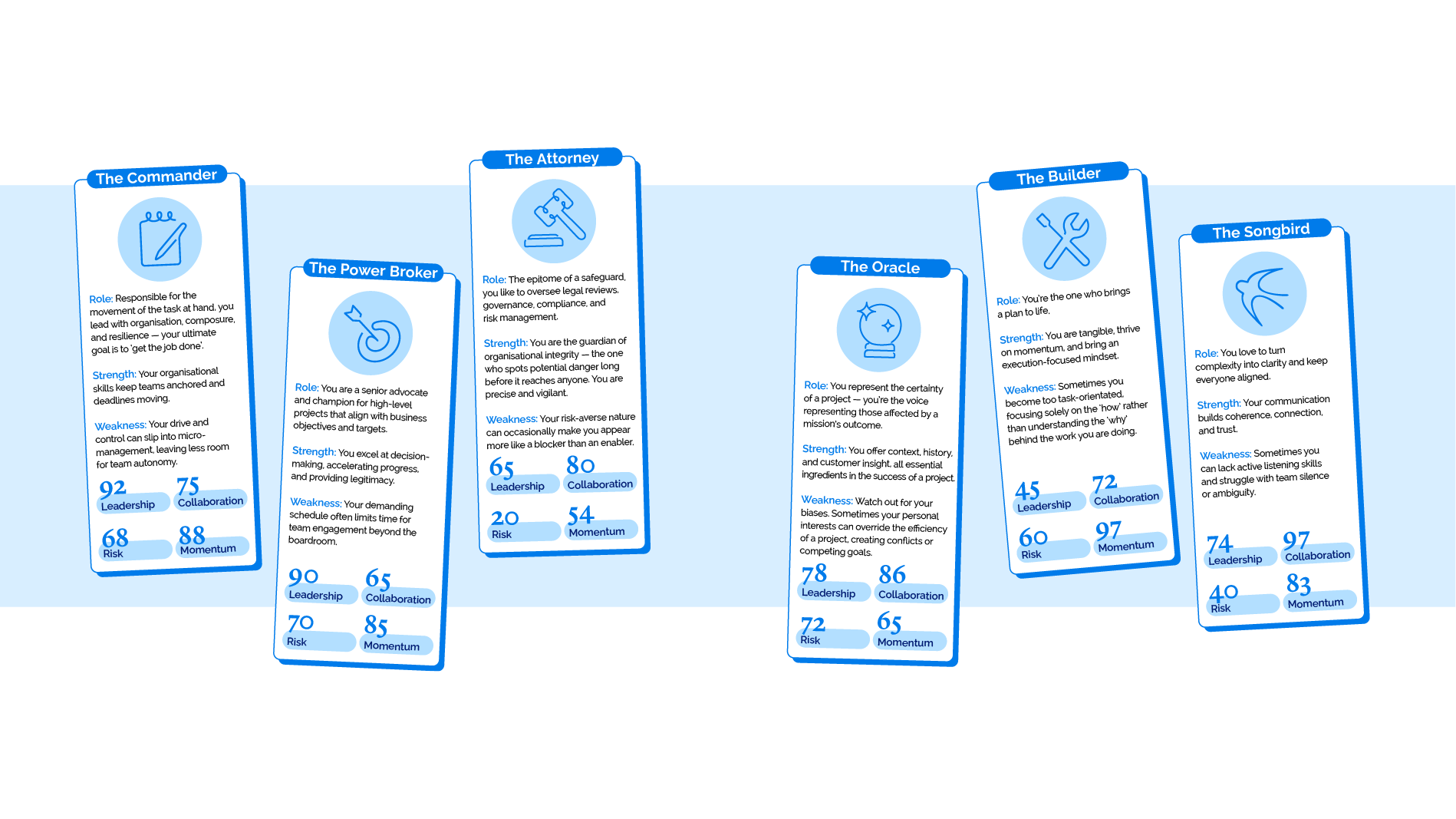
The Commander
Role: Responsible for the movement of the task at hand, you lead with organisation, composure, and resilience — your ultimate goal is to ‘get the job done’.
Strength: Your organisational skills keep teams anchored and deadlines moving.
Weakness: Your drive and control can slip into micro-management, leaving less room for team autonomy.
- Leadership: 92
- Collaboration: 75
- Risk: 68
- Momentum: 88
The Power Broker
Role: You are a senior advocate and champion for high-level projects that align with business objectives and targets.
Strength: You excel at decision-making, accelerating progress, and providing legitimacy.
Weakness: Your demanding schedule often limits time for team engagement beyond the boardroom.
- Leadership: 90
- Collaboration: 65
- Risk: 70
- Momentum: 85
The Attorney
Role: The epitome of a safeguard, you like to oversee legal reviews, governance, compliance, and risk management.
Strength: You are the guardian of organisational integrity — the one who spots potential danger long before it reaches anyone. You are precise and vigilant.
Weakness: Your risk-averse nature can occasionally make you appear more like a blocker than an enabler.
- Leadership: 65
- Collaboration: 80
- Risk: 20
- Momentum: 54
2 days course
The Oracle
Role: You represent the certainty of a project — you're the voice representing those affected by a mission’s outcome.
Strength: You offer context, history, and customer insight, all essential ingredients in the success of a project.
Weakness: Watch out for biases. Sometimes your personal interests can override the efficiency of a project, creating conflicts or competing goals.
- Leadership: 78
- Collaboration: 86
- Risk: 72
- Momentum: 65
The Builder
Role: You’re the one who brings a plan to life.
Strength: You are tangible, thrive on momentum, and bring an execution-focused mindset.
Weakness: Sometimes you become too task-orientated, focusing solely on the ‘how’ rather than understanding the ‘why’ behind what you are doing.
- Leadership: 45
- Collaboration: 72
- Risk: 60
- Momentum: 97
The Songbird
Role: You love to turn complexity into clarity and keep everyone aligned.
Strength: Your communication builds coherence, connection, and trust.
Weakness: Sometimes you can lack active listening skills and struggle with team silence or ambiguity.
- Leadership: 74
- Collaboration: 97
- Risk: 40
- Momentum: 83
2 days course
Conclusion: Bringing the Project Management Archetypes to Life
No single archetype defines a great project team — and none exists in isolation. The real power lies in understanding how these roles show up, interact, and sometimes collide in the day-to-day rhythm of work.
You may recognize yourself strongly in one archetype, or see elements of several. That’s not a flaw — it’s a strength. High-performing individuals and teams are not rigidly fixed; they flex. The Commander may need to step back and listen like the Songbird. The Builder may benefit from the foresight of the Oracle. The Power Broker might lean on the Attorney to ensure ambition doesn’t outpace integrity.
These archetypes are not labels — they are lenses. They help us:
- Understand how we naturally operate
- Appreciate the strengths others bring
- Anticipate where friction may arise
- Intentionally adapt when the situation demands it
When teams build awareness of these dynamics, collaboration becomes more deliberate, communication more effective, and outcomes more balanced.
The question, then, isn’t “Which archetype are you?”
It’s “Which archetype does this moment need you to be?”
Because the most effective project teams — and leaders — aren’t defined by a single role, but by their ability to move between them with clarity and purpose.
This article was adapted from an article originally published by Cegos UK